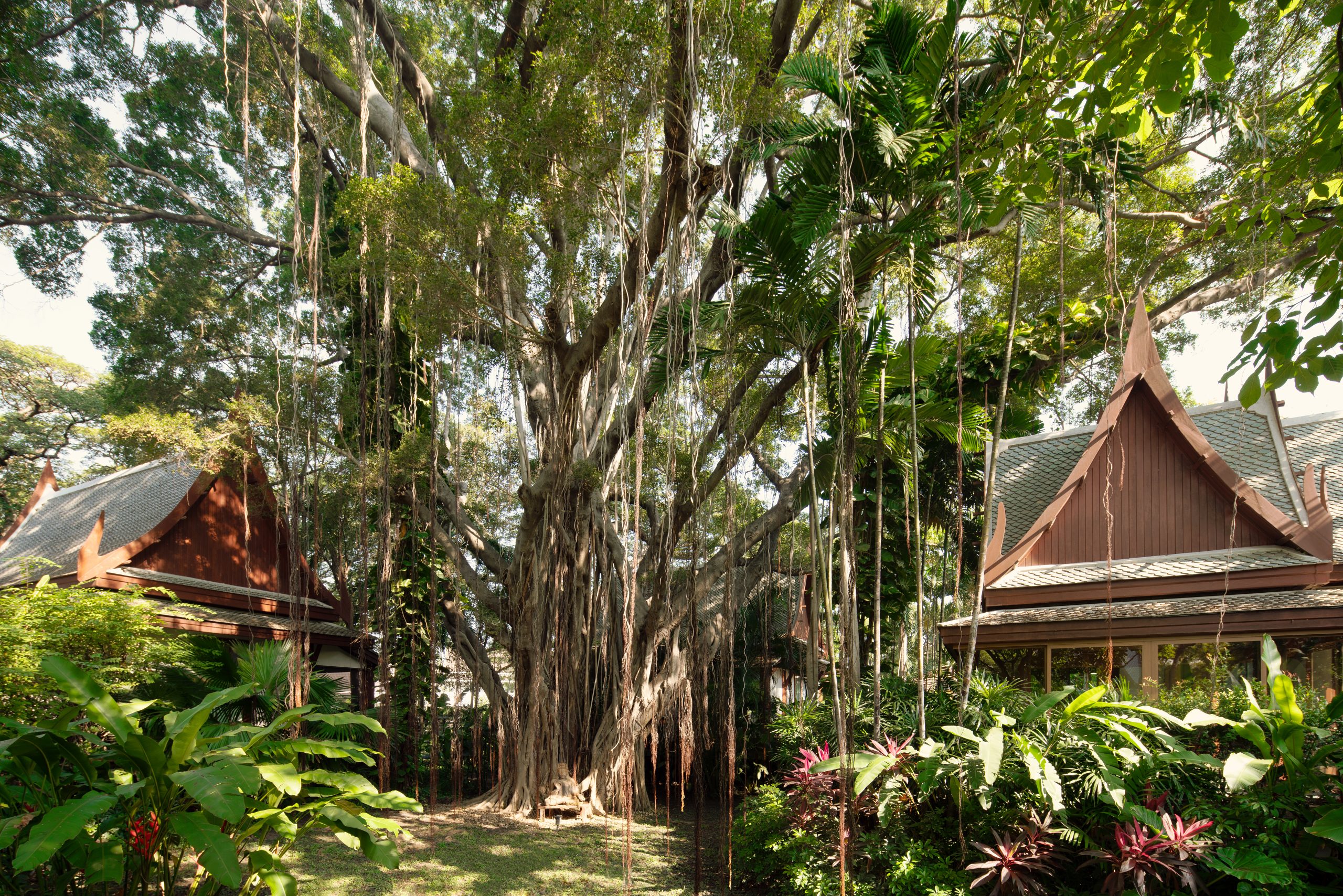
Recently, I was invited to sample the benefits of forest bathing at Chiva-Som, an award-winning health resort here in Hua Hin. I’ve written before about the awe-inspiring power of nature and know how valuable spending time outdoors can be. But I’d never participated in an official forest-bathing experience. Being curious and always open to new experiences, I gladly accepted the invitation to experience the benefits of forest bathing firsthand. To be honest, the activity was beautifully simple.
We walked quietly into the gardens and gathered in a circle while our guide sounded a singing bowl a few times. After that, we had 30 minutes to ourselves to explore.
There were no complicated instructions.
We were simply asked to honour this time with ourselves, limit our talking (in other words, don’t talk!) and explore the gardens. We could look at and touch the trees and flowers, listen to the sounds and be present with what was around us. There was plenty to notice all around us.
One thing I particularly loved was a stunning fig tree with a Buddha statue beneath it
Long roots hung down like tentacles. Some had reached the ground and taken root, forming strong supports. Above, birds sang and went about their day in the canopy, while tiny flowers floated gently to the ground like miniature parachutists drifting on the breeze.
As John Muir, a naturalist and biologist, says:
“In every walk with nature one receives far more than he seeks.”
Perhaps that is the essence of the full benefits of forest bathing? Unexpected surprises and gifts? There was plenty to notice when I gave myself time to look. I would have loved to take a photo, but of course, mobile devices were not allowed.
What fills the gaps in your day?
The experience made me think about how quickly we fill every spare moment. Sometimes we forget the simple art of being still, spending time in nature and noticing the beauty around us. One of the benefits of forest bathing.
Instead, while we wait for someone, we check our phone. Between tasks, we scroll through social media. Getting a little restless? We watch a short video or reel.
Waiting for someone? We check our phones. Driven by past habits, we automatically pick up our phones without consciously pausing to consider what we need or whether what we are doing is helping us. These actions are often driven by what I call Invisible Patterns. Powerful drivers of our choices and behaviours, yet hidden from our awareness.
What does the research tell us?
Gallup’s 2026 State of the World’s Emotional Health report offers some useful information.
Its latest complete global data, collected in 2025, found that 38% of people experienced worry and 36% experienced stress during much of the previous day.
Gallup’s research into social media use across 97 countries in 2026 also found that people using social media for two hours or more each day were more likely to report stress, worry, anger, loneliness and sadness than moderate users. Even after accounting for other factors.
The differences were small, and the research cannot tell us whether social media caused those feelings.
Moderate use was also associated with a more favourable wellbeing profile across many measures. Connecting online can have real value. However, it’s when we reach for it habitually, without consciously choosing, that it may become a problem.
For me, the useful question is:
“Am I choosing how I spend my attention, or simply following a familiar habit?”
The benefits of forest bathing can begin simply
My forest bathing experience reminded me how simple taking a break can be. You don’t need a retreat, a forest, or a special activity to spend a few minutes noticing the world around you. However, taking a longer time out in nature, or at a retreat, is a fabulous option.
Today, try leaving your phone behind as you go for a short walk. Sit outside without something to read or listen to. Look closely at a tree you normally walk past. Notice its bark, leaves, roots and the light around it.
I bet your mind wanders to the things you habitually think about: your to-do list, projects on the go, or upcoming commitments. However, see if you can become aware and gently bring your attention back to the present.
We need to train and tame our minds and awareness is often one of the benefits of forest bathing
When we become aware of where our mind goes, we have a choice to bring it back to the present moment. This is the first step in managing our attention. We start to place it where we desire, rather than letting it be directed by our habitual ways of thinking and behaving. This is how we can create different results, change our behaviours, and boost our productivity.
Additionally, we need to manage our stress levels and calm our nervous system.
Just like spending time in nature and enjoying the benefits of forest bathing, managing our stress helps support our wellbeing, promotes a sense of calm and helps regulate our nervous system.
If you’re looking for other simple ways to restore your energy and gain a fresh perspective, I’ve shared seven practical ideas in my article on how to recharge your mind and body naturally.
Remember:
“Awareness creates choice. Choice opens the door to change.”
This week, give yourself ten minutes to unplug and notice. Afterwards, ask yourself:
What did I notice when I stopped filling every moment?
Would you like more practical ways to manage stress?
If you’d like more simple, practical strategies to manage stress, calm your mind and bring greater balance into your day, explore my Stress Less Course.
About the Author
Mandy Napier is a High-Performance Mindset Coach who helps capable professionals, business owners, and leaders uncover and transform the Invisible Patterns that keep them stuck. With science-backed tools, practical coaching, and her own experiences, she helps people improve their clarity, confidence, and consistency to be the person they know they can be.
 Ready to Take the Next Step?
If this article resonated with you, start with my complimentary mini-course:
Why You Know What To Do But Don’t Do It
In less than an hour, you’ll discover why so many capable people struggle to follow through, learn how to recognise the Invisible Patterns that may be shaping your behaviour, and take the first step towards lasting change.
You can also explore my coaching programs, read my book REWIRE, or visit my Contact page. I’d love to hear from you.